If you have spent the last few years inside Marketing Cloud Engagement, the honest summary is this: Marketing Cloud Next is not an upgrade, it is a different foundation. Same vendor, same ambition, different building.
That framing matters, because almost every team that has struggled with the transition struggled for the same reason — they planned for a UI refresh and got an architecture change.
Key takeaways
- Marketing Cloud Next is a different foundation, not a new version of Marketing Cloud Engagement.
- Data lives in Data 360, automation is Flow, personalisation is expression-based rather than AMPscript.
- Your data model becomes the project. Teams that treat it as a prerequisite discover it is the whole job.
- Heavy AMPscript, SSJS and CloudPages do not port — and there is no forced end-of-life date either.
- Three honest positions: greenfield start, hybrid pilot, or plan first and move later.
The one architectural fact that explains everything else
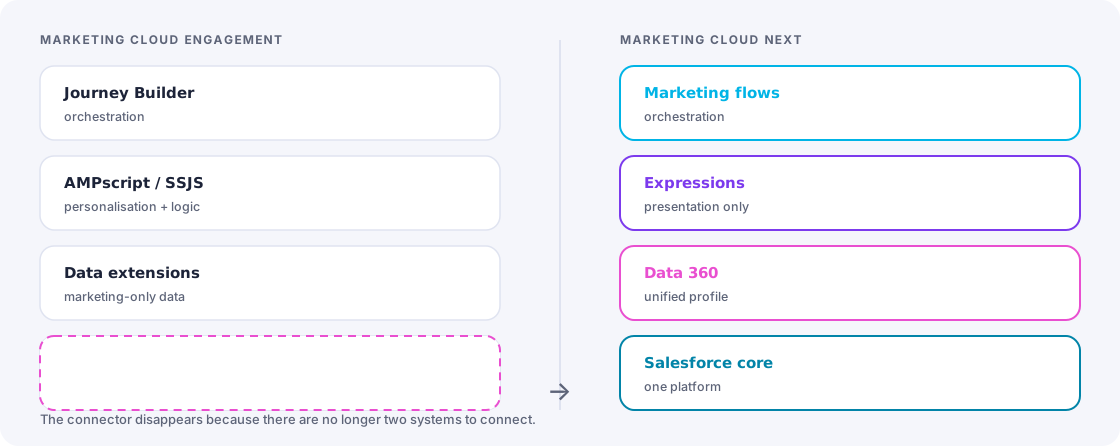
Classic Marketing Cloud Engagement grew up outside the Salesforce core. It had its own data model (data extensions), its own scripting languages, its own automation surface, and a connector that shuttled data back and forth to CRM. It was acquired technology, integrated well, but never structurally part of the platform.
Marketing Cloud Next flips that. It is built on Salesforce core, with Data 360 as the data layer and Salesforce Flow as the automation engine. That single change explains almost every difference you will notice:
- Data lives in Data 360 rather than in isolated data extensions — the same unified profile powers marketing, sales and service.
- Automation is Flow, the same builder your Salesforce admins already use, instead of a marketing-only tool.
- Personalisation moves to expression-based, Handlebars-style syntax rather than AMPscript.
- AI is native rather than bolted on, because Agentforce runs on the same platform and the same data.
- Permissions, deployment and governance are platform concerns, handled the way the rest of your org is handled.
What this means practically
1. Your data model becomes the project
In Engagement you could get a campaign live with a spreadsheet import and a bit of AMPscript. The platform was forgiving about messy data because you could always write your way around it — a lookup here, a conditional there.
In Marketing Cloud Next, the quality of your Data 360 model determines what is possible. There is no scripting escape hatch inside the message. If a personalisation needs an attribute, that attribute has to exist on the profile, which means someone has to model it, source it and keep it current.
Teams that treat data modelling as the boring prerequisite usually discover it is the whole job — and the part that decides whether personalisation actually works. This is not a criticism of the platform. It is the platform being honest about where the work always was.
2. Marketing and CRM stop being two worlds
The old connector conversation — “why did this prospect not sync?” — largely disappears, because there is no shuttle between two systems any more. That is genuinely good news, and for organisations that have spent years managing sync queues it is the single most attractive part of the proposition.
But it also means marketing changes now happen inside a platform your admins govern. Deployment goes through the org’s release process. Permissions come from the org’s permission model. A change that used to be a marketing decision may now touch a shared object.
Most teams find this is a net gain and a short-term friction. The friction is real, though, and it is organisational rather than technical: two groups who previously negotiated across a connector now have to share a change process.
3. Your existing investment does not simply lift and shift
Heavy AMPscript, server-side JavaScript, CloudPages and complex relational data extensions do not port across. There is no one-click content migration — and, just as importantly, no forced end-of-life date for Engagement either. Both facts should shape your timeline.
The instinct is to read “no automatic migration” as bad news. In practice, most estates find the rebuild removes logic rather than translating it: a template with four AMPscript blocks becomes a template with one expression, plus two modelled attributes the rest of the business can now use.
The inventory nobody wants to do
Before any migration conversation gets useful, someone has to count what is actually running: live journeys by entry volume, every code block by location, every integration by owner. It is two to three weeks of unglamorous work and it changes the conversation completely, because the argument stops being about strategy and becomes about a spreadsheet everyone can read.
4. Your team's skills shift, but less than you fear
The skill anxiety is usually about AMPscript. It should not be. AMPscript specialists are people who learned to express business logic precisely in an unforgiving environment, and that skill transfers directly to Flow and to data modelling.
The bigger shift is cultural. Marketing operations people who worked inside a marketing-only tool now need to understand the platform their work sits on: objects, permissions, sandboxes, deployment. That is a matter of weeks of learning, not years — and it makes them substantially more useful to the organisation.
| What you did in Engagement | What replaces it | Transfer difficulty |
|---|---|---|
| Data extensions and SQL query activities | Data 360 model, calculated insights, segments | Moderate — new concepts, familiar thinking |
| Automation Studio | Flow and scheduled automation | Low for the logic, moderate for the tooling |
| AMPscript personalisation | Expression syntax plus modelled attributes | Low syntactically, higher architecturally |
| Journey Builder | Marketing flows (and Journey Builder, in hybrid setups) | Low — the mental model carries over |
| CloudPages | Experience Cloud, your web platform, or a forms product | High — no direct equivalent |
The teams having the hardest time are rarely the ones with the most complex orgs. They are the ones who assumed Marketing Cloud Next was a UI refresh and planned accordingly.
What has not changed
Worth saying plainly, because the noise around the transition obscures it. Email is still email. Segmentation is still segmentation. A badly designed journey is still a badly designed journey, and a poor list is still a poor list. The disciplines that made a marketing team effective in Engagement — clear objectives, honest measurement, list hygiene, restraint about frequency — carry over unchanged.
If your programme underperforms today because of strategy rather than tooling, a platform change will not fix it. That is not an argument against moving; it is an argument for being clear-eyed about what the move is expected to deliver.
So should you move?
Three honest positions, depending on where you sit today:
- Greenfield, or light Engagement usage: start on Marketing Cloud Next. You avoid building legacy you would only have to unwind later, and the learning curve is one you will climb eventually regardless.
- Moderate estate with real appetite for agentic use cases: run hybrid. Keep existing journeys where they are and pilot Marketing Cloud Next on one new use case, so you learn on something small and reversible. Agree an explicit rule about which platform owns which contact before you start.
- Heavy custom code and business-critical journeys: plan first, move later. Inventory what you have, size the rebuild honestly, and move when your roadmap and your calendar agree — not when a webinar tells you to. Write down the conditions that would change the answer, and review them quarterly.
The question that reorders the debate
Instead of “should we migrate?”, ask “what would need to be true for a migration to go well?” The answer almost always points at the data foundation rather than at journeys — and that work pays back in Engagement, in Sales Cloud and in reporting whether or not you ever migrate. It is the least regrettable investment on the roadmap.
The takeaway
Marketing Cloud Next rewards teams who invest in data foundations and treat marketing automation as part of the Salesforce platform rather than a satellite orbiting it. The absence of a deadline is a gift, but only to organisations that use it to prepare rather than to postpone.
If your organisation is still debating which product it actually needs, have that clarity conversation before any build starts — it is the cheapest hour you will spend on the whole programme.
Frequently asked
Seeing this in your own org?
The first call is free: thirty minutes, no slides, and an honest read on what a fix would take. If it is not worth doing, you will hear that too.