Ask a marketing team why campaigns take so long and you will hear about approvals, briefs and stakeholders. Watch them work and you will see something else: the same footer rebuilt for the fourth time, the same discount logic re-written in a slightly different way, the same salutation implemented by two people who each solved it differently.
Marketing Cloud Next takes reusability seriously, and it is one of the least glamorous, highest-return areas to get right early.
Key takeaways
- Speed differences between marketing teams come from reuse, not from talent.
- Reuse operates at four levels: tokens, components, logic and audiences. Most teams only think about the second.
- Lock the components everyone shares — a footer campaign builders can edit is not a shared footer.
- Reuse rate is measurable. Track the share of sends assembled from existing pieces.
- The payoff shows up at brand-refresh time, when a change lands in one place instead of thirty.
The rebuild tax
Every time a marketer recreates something that already exists, the organisation pays three times: once for the build, once for the review, and once later when the two versions diverge and somebody has to work out which is correct.
That third cost is the expensive one, and it is invisible on any timesheet. It shows up as “why does this email have last year’s legal text”, as a brand refresh that takes a quarter, and as a new hire who cannot tell which of four templates is the current one.
Four levels of reuse
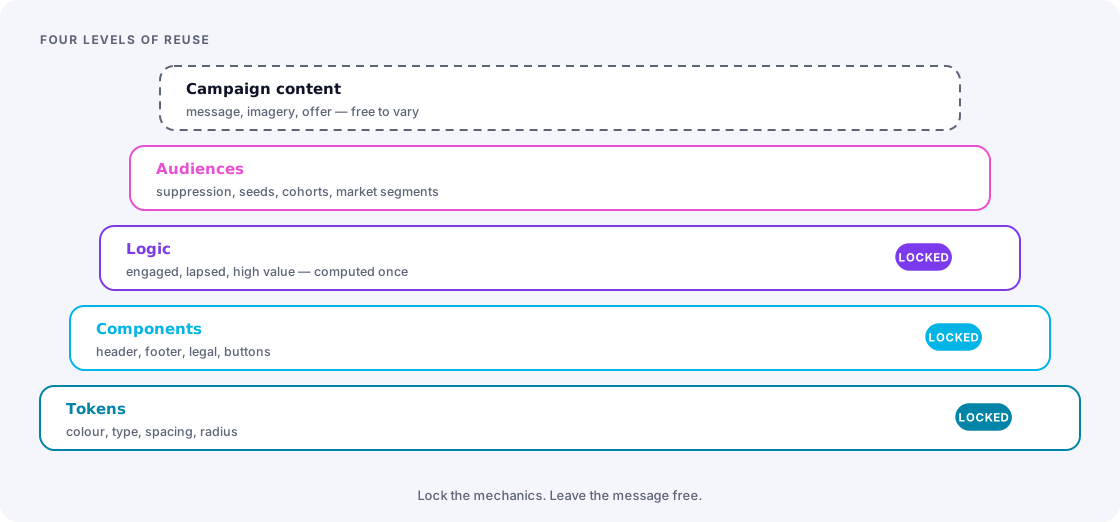
Level 1 — Tokens
Colour, type scale, spacing, button styling, corner radius. The visual vocabulary. Defined once, referenced everywhere, never hard-coded into an individual asset.
This is the layer that decides whether a rebrand is a change or a project. If your brand colour appears as a hex value inside thirty templates, a refresh means finding all thirty. If it is a token, it means changing one line.
Level 2 — Components
Header, footer, legal block, preference-centre link, social row, product tile, button. The parts of a message that are the same across campaigns.
Two decisions determine whether these help or hurt. Who can edit them: shared components must be locked, or they are not shared — they are a starting point that will drift into six variants within a year. How deeply they nest: two levels is the practical limit before “why did this render like that” becomes an afternoon.
The four worth centralising first are the ones carrying compliance and consistency risk: legal footer, unsubscribe and preference links, brand header, and the button component.
Make requests visible instead of blocking them
Locking components creates a queue, and a queue creates workarounds. Handle it by making requests cheap and visible: a named owner, a short turnaround, and a log of every “I needed something the component could not do.” Those notes tell you exactly which gap to close in the next revision — and they turn the lock from an obstacle into a feedback loop.
Level 3 — Logic
This is the level most teams skip, and it is where the largest return sits.
Every marketing organisation has a set of definitions it uses constantly: engaged, active customer, lapsed, high value, at risk, eligible for the loyalty upgrade. In a low-reuse estate, each of those is re-expressed inside every segment and every message that needs it — slightly differently each time.
Computed once in the data layer, they become shared vocabulary. Twenty segments reference one definition of “engaged” instead of containing twenty near-identical versions of it. When the definition changes, it changes everywhere at once, and reporting stops disagreeing with campaign targeting.
| Without shared logic | With shared logic |
|---|---|
| “Engaged” defined inside each segment | One computed attribute, referenced by all |
| Reporting and targeting quietly disagree | Both read the same definition |
| Changing the rule means finding every use | Change once, propagates everywhere |
| Nobody can answer “what counts as active?” | One documented answer |
Level 4 — Audiences
The top layer, and the one that most directly affects speed to launch. Shared, maintained audiences — suppression lists, seed lists, employee exclusions, high-value cohorts, market segments — mean a new campaign starts from something rather than from nothing.
The rule that keeps this clean: separate audience (who this campaign is for — a marketing decision) from eligibility (who we are allowed and able to contact — consent, suppression, frequency). Eligibility should apply automatically to everything rather than being copied into each definition, because a rule that has to be remembered will eventually be forgotten.
The definitions register
One page, kept current, listing every shared computed attribute and audience: name, plain-English definition, refresh cadence, owner.
It sounds trivial. It prevents more reporting arguments than any dashboard, because when someone asks “what counts as active?” there is a single answer that both the campaign team and the analytics team are reading from. It also makes onboarding dramatically faster — a new marketer can read one page instead of reverse-engineering twenty segment definitions.
Measuring reuse
If you want reuse to improve, measure it. Three numbers, reviewed monthly:
- Reuse rate — the share of sends built entirely from existing templates and components with no new bespoke elements. Rising is good.
- Component count — how many shared components exist. Should grow slowly and occasionally shrink. Rapid growth means the library is fragmenting rather than consolidating.
- Cycle time — median brief to send. This is the number leadership cares about, and it is the one reuse actually moves.
A fourth, worth watching when you introduce locking: the duplication-request log. High volume early is expected and healthy. High volume six months in means the component set does not fit the work, which is a design problem rather than a discipline problem.
Reuse can go too far
A component set so rigid that every campaign looks identical is its own failure. The goal is to remove repetition, not variation. Lock the mechanics — brand, legal, structure, accessibility — and leave the message, the imagery and the offer entirely free.
Where to start
For a team with no reuse discipline today, the sequence that produces visible results fastest:
- Week one: centralise and lock the legal footer and the unsubscribe block. Immediate compliance win, no debate.
- Week two: extract tokens — colours, type, spacing, buttons — out of templates.
- Week three: write the definitions register for the five terms your team argues about most.
- Week four: consolidate templates down to three families and set the duplication rule.
- Ongoing: the monthly numbers, and the request log.
The takeaway
Reusability is not a technical feature you switch on. It is four layers of deliberate decisions — tokens, components, logic, audiences — plus a register that says what things mean and a lock that stops them drifting.
The compounding is real but it is slow, which is why it gets deprioritised. It becomes visible all at once on the day a rebrand lands in one place instead of thirty, and on the day a new hire ships a correct, on-brand, compliant email in their first week.
Frequently asked
Seeing this in your own org?
The first call is free: thirty minutes, no slides, and an honest read on what a fix would take. If it is not worth doing, you will hear that too.