Every Account Engagement org has a scoring model. Very few have one anybody uses. The number sits on the prospect record, the sales team ignores it, and marketing quietly reports MQL volume that nobody downstream believes.
The cause is almost always the same: the model was configured rather than designed. Someone accepted the defaults, adjusted a few point values, and the threshold was set at whatever produced a comfortable volume. There is no statement anywhere of what the number is supposed to mean.
Key takeaways
- Score and grade answer different questions. Using one without the other is the root cause of most bad handoffs.
- Behavioural interest is perishable. Without decay, your top scores are people who were interested last year.
- Negative scoring is weaker than suppression. Disqualification should be a rule, not a subtraction.
- Set the threshold from sales capacity and observed conversion, not from a round number.
- Review with sales monthly. The review is the system; the point values are just its current state.
Two dimensions, not one
Account Engagement gives you both a numeric score and a letter grade, and they exist to answer different questions:
- Score = interest. Behaviour. What has this person done, and how recently? Volatile by design.
- Grade = fit. Firmographics and role. Do they look like someone who buys from us? Slow-moving.
Used together they produce four meaningful quadrants, and each deserves a different action:
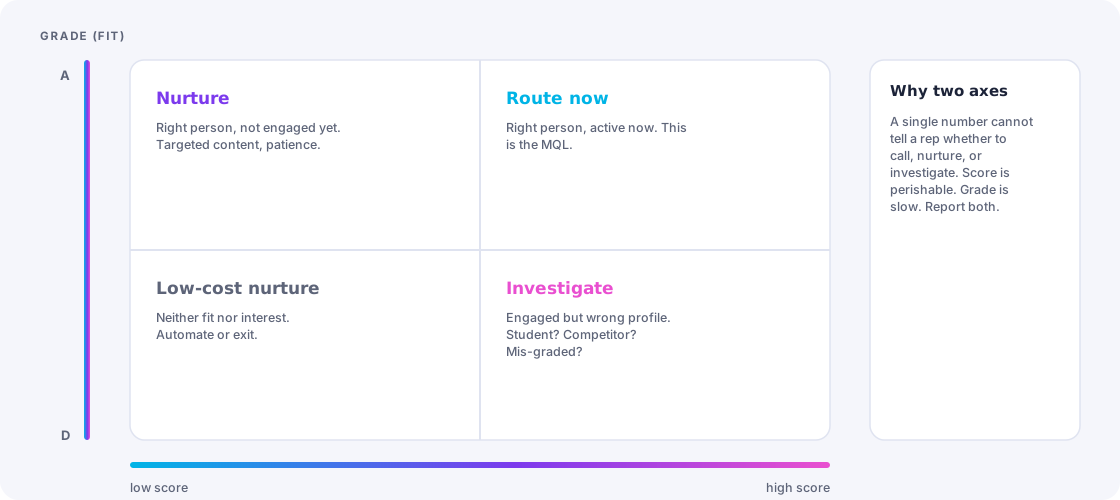
| Quadrant | Meaning | Action |
|---|---|---|
| High grade, high score | Right person, active now | Route to sales immediately. This is the MQL. |
| High grade, low score | Right person, not engaged yet | Nurture with targeted content. High-value patience. |
| Low grade, high score | Very engaged, wrong profile | Investigate before dismissing — may be a student, a competitor, or a champion at a subsidiary you have mis-graded. |
| Low grade, low score | Neither | Low-cost automated nurture, or exit the database. |
Most organisations that only use score end up sending the third quadrant to sales — high activity, wrong profile — which is exactly the experience that teaches reps to stop opening MQL notifications.
Designing the grading profile
Grading is easier to get right and usually more neglected. Build it from your actual closed-won customers, not from an aspirational ICP slide.
- Pull your last 50 to 100 closed-won deals. Note industry, employee count, region, and the job title of the person who first engaged.
- Find the concentrations. If 70% sit in three industries and one size band, that is your A grade and it is evidence-based rather than opinion-based.
- Do the same for closed-lost and disqualified. The negative pattern is often sharper than the positive one and tells you what to grade down.
- Build the profile with a small number of criteria. Industry, size, region, seniority. Four criteria that reflect reality beat twelve that reflect a workshop.
- Handle missing data explicitly. A prospect with no company size should not silently grade well. Decide whether unknown grades neutral or down, and be consistent.
Grading requires data you may not collect
If your forms capture only email and name, your grading profile has nothing to work with, and every prospect sits at the default grade. Fix the input before tuning the model: progressive profiling, enrichment, or account-level data from the CRM. Grading is downstream of data capture, and no amount of model design compensates for empty fields.
Designing the scoring model
Score the intent, not the activity
Not all engagement is equal, and point values should express a genuine hierarchy of intent. A pricing-page visit and a newsletter open are not the same event with different numbers — they are different kinds of signal. Roughly:
| Signal strength | Examples | Relative weight |
|---|---|---|
| Buying intent | Pricing page, demo request, contact form, comparison content, repeat visits within days | Highest — and hand-raisers should bypass scoring entirely |
| Solution research | Product pages, case studies, technical documentation, webinar attendance | High |
| Problem awareness | Blog posts, top-of-funnel guides, newsletter clicks | Low to moderate |
| Passive | Email opens, single page views from a broad campaign | Minimal. Opens in particular are an unreliable signal. |
Make interest perishable
This is the single most impactful change in most rebuilds. Without decay, scores only ever go up, and your highest-scoring prospects become the people who were most engaged eighteen months ago and have done nothing since.
Implement decay as scheduled automation: reduce score by a defined amount or percentage after a defined period of inactivity, repeating. The specific parameters should follow your sales cycle — a three-week B2C-style cycle and a nine-month enterprise cycle need very different half-lives. What matters is that a score reflects current interest, so that when a rep opens the record the number is about this month.
Show the trend, not just the value
Surface score change over the last 14 or 30 days on the prospect and lead record. “72, up 40 this week” is an actionable sales signal. “72” is trivia. This one field changes how reps use the model more than any tuning of point values.
Prefer suppression over negative scoring
Negative points feel like the right tool for disqualification, and they are not. Points can always be out-voted by enough positive activity, so a determined competitor browsing your site will eventually cross the threshold anyway.
Use hard suppression rules for: competitor domains, personal free-mail domains where your business only sells B2B, students and job applicants, employees and contractors, existing customers who should route to account management, and countries you do not serve.
Reserve genuine negative scoring for reversible disengagement signals — an unsubscribe from a specific stream, a bounced email, a long period of inactivity. Things that reflect cooling interest rather than fundamental unsuitability.
Setting the threshold
The threshold is a capacity decision as much as a quality one. Three inputs:
- Sales capacity. How many new leads can your team genuinely work well per week? Sending more than that does not increase pipeline; it increases the number of leads worked badly.
- Observed conversion. Look back at prospects who became opportunities and find where their score and grade sat at the moment of conversion. That distribution is your evidence.
- Cost of a miss. High-value, low-volume businesses should set the threshold lower and accept more false positives. High-volume businesses should set it higher.
Then commit to it publicly with sales, and hold it for at least a quarter before adjusting. A threshold that moves monthly cannot be evaluated, because you never see a full cycle at a stable setting.
The review cadence is the actual system
A scoring model is a hypothesis. It is only worth anything if you check it against outcomes.
Monthly, 45 minutes, with sales in the room, four things on screen:
- MQL volume against capacity. Are we sending a workable number?
- Disposition breakdown. What are reps saying about quality, in their own controlled-vocabulary categories?
- Conversion by score and grade band. Does a higher score actually convert better? If not, the model is decorative.
- The misses. Two or three opportunities that never became MQLs. What did the model not see?
That fourth item is the one people skip and the one that improves the model fastest. Opportunities created from prospects the model ignored tell you precisely which signal is missing.
A rebuild sequence that works
If you are starting from a default or degraded model, resist the temptation to fix everything at once:
- Week one: suppression rules. Immediate quality improvement, no model change, no debate required.
- Week two: grading profile from closed-won evidence. This is where the biggest lift usually is.
- Week three: scoring hierarchy and decay, run in parallel with the old score so you can compare.
- Week four: threshold set from the parallel-run data, agreed with sales.
- Ongoing: the monthly review, with a written change each time or an explicit decision to change nothing.
The takeaway
A scoring model earns trust by being explainable, current and accountable. Explainable means score and grade separated, with a written definition of what an MQL promises. Current means decay. Accountable means a monthly review where sales feedback visibly changes something.
Get those three and the number on the record stops being decoration and starts being the reason a rep picks up the phone.
Frequently asked
Seeing this in your own org?
The first call is free: thirty minutes, no slides, and an honest read on what a fix would take. If it is not worth doing, you will hear that too.