Ask a marketing leader what is broken and you will often hear “sales does not work our leads.” Ask the sales leader the same question and you hear “marketing sends us rubbish.” Both are describing the same object from opposite ends: a handoff that was never actually designed, only configured.
This is one of the few problems in a Salesforce estate that you can fix without buying anything. It needs four decisions, a service-level agreement that both sides sign, and a feedback loop that survives contact with a quarter-end.
Key takeaways
- An MQL is a promise, not a score. Define what marketing is promising before you define the threshold.
- Handoffs fail on context, timing and accountability — in that order of frequency.
- Every MQL needs a named owner within a defined window, and a disposition reason that comes back to marketing.
- Campaign attribution only becomes credible once campaign membership is created automatically and consistently.
- Review disposition data monthly with sales in the room. That meeting is the actual alignment mechanism; the scoring model is just its output.
Start with the promise, not the score
Most scoring models are built backwards: someone picks point values, watches the volume, and tunes until the number of MQLs per month looks reasonable. The result is a threshold with no meaning, which is exactly why sales does not trust it.
Invert it. Write one sentence that both teams can defend:
“When we send you an MQL, we are saying: this person works at a company that fits our ICP, they have shown intent in the last 14 days, and they are senior enough to influence a purchase.”
Now the score has a job. Fit criteria become grading. Intent becomes scoring with decay. Seniority becomes a data-completeness requirement, which tells you what your forms must capture. And critically, sales has something specific to disagree with — which is far more productive than disagreeing with a number.
The four decisions
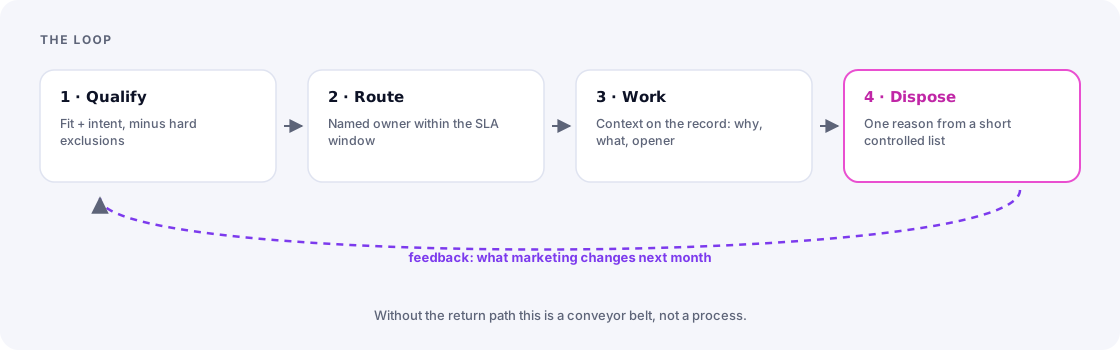
1. What qualifies — and what disqualifies
Disqualification is the half everyone forgets. Students, competitors, existing customers, job applicants, current open opportunities, and anyone in a country you do not sell to should never reach a rep as a new MQL. Build these as hard suppressions, not as negative points, because a large enough positive score will always eventually out-vote a negative one.
| Signal type | Mechanism | Why |
|---|---|---|
| Company fit (industry, size, region) | Grade / firmographic profile | Slow-changing, describes the account not the person |
| Behavioural intent | Score with decay | Perishable — a whitepaper read in March is not intent in July |
| Explicit request (demo, pricing, contact) | Immediate bypass to sales | Never make a hand-raiser wait for a score to accumulate |
| Exclusions (competitor, student, employee) | Hard suppression | Points can be out-voted; suppressions cannot |
2. Who owns it, and how fast
An MQL with no named owner is a notification, and notifications get archived. Assignment must be automatic, must resolve to a person rather than a queue wherever possible, and must happen within minutes rather than as part of an overnight batch.
Then agree a working-hours SLA — first attempt within a defined window, a defined number of attempts across a defined number of days, and an explicit rule for what happens when the window is missed. The specific numbers matter less than the fact that both leaders committed to them in writing.
Round-robin is not routing
Even distribution optimises for fairness between reps. It does not optimise for conversion. If your territories, verticals or languages matter to the buyer, they should matter to the assignment rule — and if a rep is out, the rule needs a fallback, or leads sit unworked in a personal queue for a week.
3. What context travels with the lead
This is the cheapest, highest-return change available, and most orgs skip it. A rep opening a lead record should be able to answer three questions in under fifteen seconds without clicking anything: why is this person here now, what have they looked at, and what should I open with?
Practically that means surfacing, on the record page: the most recent three meaningful activities with dates, the campaign or content that triggered qualification, the fit reason, and the score trend rather than the score. A score of 78 tells a rep nothing. “78, up from 12 in nine days, after two pricing-page visits” tells them exactly how to open the call.
4. What comes back
Every MQL must end in a disposition, chosen from a short controlled list — not free text. Something like: converted to opportunity, qualified but not now, wrong role, wrong company, no contact after full attempt sequence, duplicate, or bad data.
Two rules make this work. The list must be short enough that reps pick honestly rather than defaulting. And marketing must be visibly seen to act on it — if “wrong role” spikes for one campaign, that campaign’s targeting changes and marketing says so out loud in the monthly review. Reps stop filling in disposition the moment they conclude nobody reads it.
Making attribution credible
Attribution arguments are usually data-quality arguments wearing a costume. Before debating first-touch versus multi-touch models, get three mechanics right:
- Campaign membership is created automatically. Every form, event import, ad sync and content download writes a campaign member with a status, without anyone remembering to do it. Manual membership means gaps, and gaps mean somebody’s channel looks worse than it is.
- Campaign member statuses mean the same thing everywhere. Standardise them across campaign types. “Responded” must not mean “attended” on one campaign and “clicked” on another, or your funnel maths is fiction.
- Campaign hierarchy reflects how you actually budget. If the business plans by programme and reports by channel, build the hierarchy so both roll up cleanly. Retrofitting a hierarchy across a year of campaign records is miserable work.
With those in place, most organisations find a simple model is enough: first touch to understand what creates demand, last touch before opportunity to understand what converts it, and full-path influence for the deals big enough to justify the analysis. The sophisticated model is rarely the constraint. The plumbing is.
The monthly review is the real system
Configuration does not create alignment; a recurring meeting with evidence in it does. Book 45 minutes a month with marketing and sales leadership and put four numbers on the screen:
- MQLs created, and how many were worked inside the SLA
- Disposition breakdown, with the biggest rejection reason named
- MQL to opportunity conversion, split by source
- One decision: what changes in the model before next month
The last line is the one that matters. A review that produces no change teaches both teams that the process is theatre. A review that visibly tightens targeting after two months of “wrong role” feedback teaches reps that disposition data is worth their thirty seconds — and that is the flywheel.
Sequencing for teams starting from zero
Do not rebuild scoring first. Start with exclusions and routing (week one), then context on the record page (week two), then disposition reasons and the monthly review (week three). Scoring last. Fixing the model before fixing the handoff just produces better leads that still get ignored.
The takeaway
Sales trust is not won by a more sophisticated algorithm. It is won by a handoff where the promise is written down, the owner is named, the context is visible, the clock is agreed, and the feedback visibly changes something. Get those five right and the scoring model becomes a maintenance task rather than a standing argument.
Frequently asked
Seeing this in your own org?
The first call is free: thirty minutes, no slides, and an honest read on what a fix would take. If it is not worth doing, you will hear that too.