Open almost any Engagement Studio program and you find the same shape: send email one, wait five days, send email two, wait five days, send email three, end. It is a drip, not a nurture, and it treats every prospect identically regardless of what they do.
The programs that actually convert share a different structure. They branch on behaviour, they have exits that fire before the sequence ends, and they are built to reach a decision rather than to run out of content.
Key takeaways
- Every program needs a stated goal and a defined end state. “Nurture” is not a goal.
- Exit rules matter more than entry rules. A prospect who converts should leave immediately.
- Branch on behaviour, not on a schedule. Otherwise the program is a mailing list with delays.
- One program should serve one audience with one objective. Combined programs become unmaintainable within a year.
- Suppression is program design, not an afterthought — customers, open opportunities and active sales conversations should never receive nurture mail.
Start with the decision the program exists to force
Before any build, answer one question: what should be different about this person when they leave?
Good answers are specific and testable. They have requested a demo. They have been qualified out. They have self-identified a use case. They have re-engaged after dormancy. They have completed onboarding step three.
Bad answers: “they are more educated about our product,” “they stay warm,” “they remember us.” Those cannot be measured, which means the program cannot be evaluated, which means it will run unchanged for three years.
The one-sentence test
Write: “This program takes [audience] who [entry condition] and moves them to [exit state] within [timeframe], measured by [metric].” If you cannot complete that sentence, the program is not ready to build — and the gap is usually a missing decision, not missing content.
Five patterns that work
1. The qualification ladder
Goal: establish whether a new prospect is worth sales time.
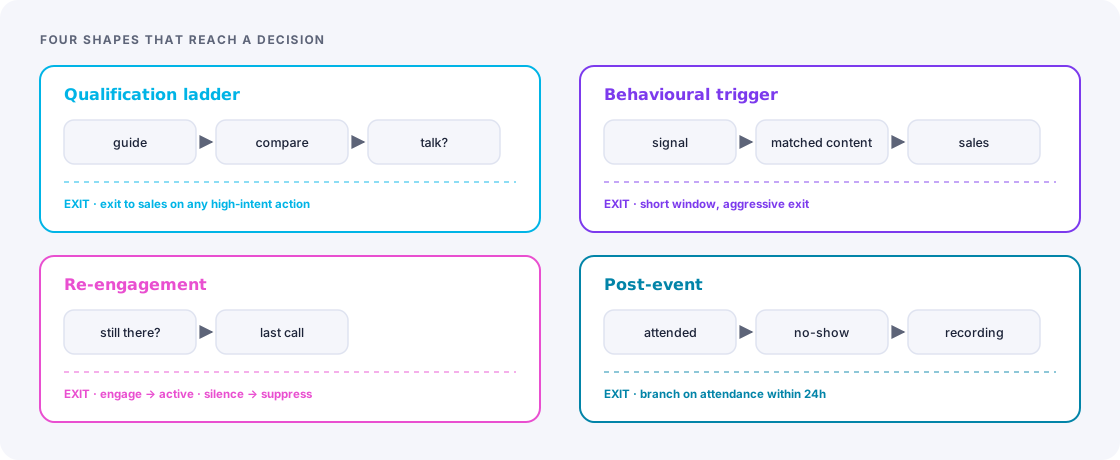
Three to four touches, each offering progressively higher-commitment content: a useful guide, then a comparison or ROI resource, then an invitation to talk. Branch after each: engaged prospects move faster and skip ahead, unengaged ones drop to a slower track. Exit to sales on any high-intent action; exit to long-term nurture if the ladder completes with no engagement.
Why it works: it reaches a verdict quickly and does not spend six weeks educating someone who was never going to buy.
2. The behavioural trigger branch
Goal: respond to a specific signal while it is still warm.
Entry is a single meaningful action — a pricing-page visit, a specific asset download, repeated visits within a short window. The program then delivers content matched to that signal, with a short window and an aggressive exit to sales.
Why it works: relevance and timing are the two things a generic nurture cannot provide, and this pattern is built entirely from both.
3. The re-engagement decision
Goal: find out whether a dormant contact is still there.
Two or three emails, plainly written, with an explicit ask: are you still interested? Anyone who engages returns to active nurture. Anyone who does not is suppressed from regular sending at the end.
Why it works: it converts a slow deliverability liability into a clean answer, and the suppression at the end is the point rather than a failure.
4. Post-event follow-up
Goal: convert attention earned at a webinar, conference or event.
Branch immediately on attendance: attendees get a recap and a next step, registrants who did not attend get the recording, and no-shows who never open get a single further attempt and then exit. Speed matters more than polish — this program should start within 24 hours.
Why it works: it treats three genuinely different behaviours differently, instead of sending everyone the same “thanks for attending” that half of them did not.
5. Onboarding and adoption
Goal: get a new customer to a defined activation milestone.
Sequenced by milestone rather than by time. Each step checks whether the prior milestone is complete: if yes, advance; if no, send help for that specific step. Exit on activation, escalate to a human on repeated non-completion.
Why it works: it is the clearest case of behaviour-driven branching, and the exit condition is unambiguous.
Four anti-patterns
The endless drip
Twelve emails, evenly spaced, no branching, no exit except the end of the list. Everyone receives everything regardless of what they do. This trains prospects to ignore you and generates unsubscribes at the point where the content stops being relevant — which, without branching, is immediately for most of the audience.
The program with no exit for success
A prospect requests a demo in week two and keeps receiving “have you considered our solution?” emails for another month because the program has no exit rule for conversion. This is the single most damaging and most common defect, because the person it embarrasses you in front of is the one who was buying.
Every program needs four exits
Success: they did the thing — leave immediately. Disqualification: they are not a fit — leave and suppress. Escalation: a human took over — leave. Timeout: the window closed — leave to a slower track. A program missing any of these will eventually send something inappropriate to someone who matters.
The everything program
One program serving new leads, existing customers, event attendees and re-engagement, held together by nested rules. It works for a quarter, then becomes unmaintainable, and eventually nobody dares change it. Split by audience and objective; three simple programs beat one clever one every time.
The unsuppressed nurture
Nurture reaching existing customers, prospects with an open opportunity, or people in active sales conversations. Undermines the sales relationship, confuses the recipient, and makes marketing look uncoordinated. Suppression rules belong in the program design from the first draft.
Construction details that matter
Entry criteria
Prefer a dynamic list where continuous entry is intended, and a static list where the cohort should be fixed. Mixing them up is how prospects re-enter a program they already completed. Also decide explicitly whether re-entry is allowed and, if so, after how long.
Wait steps
Waits should reflect buying rhythm, not convenience. A short wait after a high-intent trigger; longer waits in a slow-cycle nurture. Also mind the day of week: a wait that lands sends on Saturday morning across a whole audience is a fixable problem that most programs ignore.
Branch conditions
Branch on the strongest available signal. Clicks over opens, page visits over clicks, form submissions over page visits. Open-based branching is unreliable — inflated opens from image pre-fetching mean a branch conditioned on “opened” routes people who never saw the email.
Testing before launch
Run every path with test prospects before going live. Specifically test: the success exit fires, the suppression rules hold, a prospect who does nothing reaches the timeout exit, and the branch conditions route correctly. Programs are harder to debug once live prospects are distributed across twelve steps.
Reviewing a program that is already running
For an existing estate, a review usually finds more value than a new build. Five questions per program:
- How many prospects entered in the last 90 days? Zero means it is dormant scope — pause it.
- What percentage reach the intended exit versus timing out? A very low success rate means the goal is wrong or the content is not doing its job.
- Does the success exit actually exist and fire? Check a real converted prospect and confirm they left.
- What are the unsubscribe and complaint rates per step? A spike at one step names the email to fix.
- Who owns it? If nobody can say, that is the first finding.
Running this across a dozen programs typically produces a short list: three to pause, two to fix, one that is genuinely working and should be copied as the template for the rest.
The takeaway
A nurture program is not a content schedule. It is a mechanism for reaching a decision about a prospect faster than doing nothing would. Give it one audience, one objective, branches that respond to behaviour, and four exits — and it stops being a queue of emails and starts being a system that produces answers.
Frequently asked
Seeing this in your own org?
The first call is free: thirty minutes, no slides, and an honest read on what a fix would take. If it is not worth doing, you will hear that too.